An Example of Vibe Malware Analysis
Introduction
While talking with a friend he recently mentioned having found a suspicious process running on his server. It was strange because he had gotten high network activity warnings a few days prior and then there was a process named softirq eating up almost 100% of the server’s CPU. Thankfully he had a copy of the server’s state and I was able to get a copy. Turns out there were actually three very suspicious binaries. This presented an interesting opportunity to try something like “vibe reversing” which I’ve been interested in testing. I used IDAPro-MCP with OpenAI’s codex agent using GPT-5.4. While it would be interesting to 100% understand this malware, the real goal of this post is to see how well AI can analyze it.
Human Summary
There were three main binaries that were found to be suspicious:
- rondo
ELF 64-bit LSB executable, x86-64, version 1 (SYSV), statically linked, stripped - bot
ELF 64-bit LSB executable, x86-64, version 1 (GNU/Linux), statically linked, BuildID[sha1]=0b4fdd913a24f4c81000ff42199995dd85477c18, for GNU/Linux 3.2.0, not stripped - softirq
ELF 64-bit LSB executable, x86-64, version 1 (SYSV), statically linked, BuildID[sha1]=7957727edae3fe27250377f345994aa2ba7f5143, stripped
Sample: softirq
The softirq binary is the main XMR crypto miner. Instantly I saw crypto related strings:
cryptonight/0
cryptonight-monerov7
cryptonight/msr
...
|         GhostRider tuning results         |
...
XMRig 6.25.0\n built on Dec 23 2025 with GCC
This “GhostRider” string can clearly be seen in xmirgCC. The message identifying XMRig is obviously from XMRig. The date and time stamp is interesting though showing that this was compiled around six months before the discovery date. Looking at the basics of XMRig works it became clear that I would need a configuration file in order to see how the miner was actually configured.
config.json
.xmrig.json
.config/xmrig.json
However, there was not a doubt in my mind that this was malware. The binary name softirq is designed to discourage curious users into thinking it’s legitimate part of the operating system.
Sample: bot
The bot binary was not stripped and contained interesting symbol names and tons of hex strings such as “24015a5e7d9290920ec9711ce3c7463242c61405c562de1ac9489bff307336ec”. These seem to be used by the function aes_decrypt_hex_string. Clearly there is attempt here to obfuscate some strings. I also observed many HTTP related functions indicating possible communication over HTTP.
Sample: rondo
The rondo binary was a stripped binary containing a very large main function. Inside I could see a series of functions which looked as if they decrypted data within the .data section. There were no interesting strings except npxXoudifFeEgGaACSncs[ which appeared to be used in sometype of complex looping function.
AI Findings
After these very brief human reviews I decided to see how AI would handle them.
This is the prompt I started with:
Using the IDA mcp server, analyze the loaded binary file. It is a possbile malware sample. Do not directly run the binary. Look for hints of common malware behaviors and known malware API call patterns.
Each sample took around 3-8 minutes to process and invoked many IDA MCP tool calls. I then asked to be written to a markdown file repot. Here are the three AI reports:
Sample
- File:
softirq - IDA database:
softirq.i64 - Architecture:
x86_64ELF - SHA-256:
96fc528ca5e7d1c2b3add5e31b8797cb126f704976c8fbeaecdbf0aa4309ad46 - MD5:
cf127d66124c390ca0f0b42c6385c3c8
Scope
This report is based on static analysis performed through the IDA MCP server only. The binary was not executed.
Assessment
The loaded binary appears to be a statically linked Linux build of XMRig 6.25.0 rather than a generic unknown loader. The code and strings strongly indicate a Monero cryptominer.
Findings
1. Clear cryptominer identification
Function sub_458770 at 0x458770 prints version and help text identifying the program as XMRig:
XMRig 6.25.0Usage: xmrig [OPTIONS]
Related strings found in the binary include:
xmrigminerwallet_addresspool_walletstratum+ssl://randomx.xmrig.com:443donate.ssl.xmrig.comapi.xmrig.com
2. Mining pool and job-handling logic
Function sub_45F860 at 0x45F860 parses fields consistent with Stratum-style mining jobs:
job_idalgoblobextra_noncepool_walletsig_key
This behavior matches a Monero miner communicating with mining pools.
3. Configuration loading
Function sub_44AED0 at 0x44AED0 attempts to load configuration from:
config.json.xmrig.json.config/xmrig.json
This is consistent with standard XMRig configuration handling.
4. External command execution capability
Function sub_9C10C4 at 0x9C10C4 is a wrapper around /bin/sh -c.
Function sub_6018D0 at 0x6018D0 uses that wrapper to execute:
/sbin/modprobe msr allow_writes=on > /dev/null 2>&1
This enables MSR access for CPU tuning related to RandomX mining performance. This is a real shell execution path, but it is consistent with miner optimization and not, by itself, evidence of a second-stage payload.
5. Host tuning and mining performance logic
The sample contains strings and logic related to:
- RandomX
- huge pages
- MSR access
/dev/cpu/{}/msr/proc/sys/vm/nr_hugepages/sys/module/msr/parameters/allow_writes
These are common in high-performance CPU cryptominers.
Malware-Relevant Behavior Summary
The sample demonstrates behavior commonly associated with unauthorized cryptomining:
- Mining pool connectivity
- Wallet-based mining configuration
- Background mining support
- CPU and memory tuning for RandomX
- Shell-based system configuration for MSR access
If this binary was deployed without user consent, it should be treated as malware based on cryptomining behavior.
What Was Not Observed
In the areas inspected, I did not find clear evidence of:
- persistence via
cron,systemd,rc.local, or SSH key installation - anti-debugging checks such as
ptrace,TracerPid,gdb, orstrace - anti-VM checks referencing
vmware,virtualbox, orqemu - a broader RAT or downloader feature set
Conclusion
This sample is best classified as a Linux XMRig-based cryptominer. Based on the static evidence reviewed, it looks more like the miner binary itself than a multifunction backdoor, loader, or RAT.
Key Functions
0x458770- version/help output, identifies XMRig0x45F860- mining job parsing and pool-related handling0x44AED0- configuration file loading0x9C10C4-/bin/sh -cexecution wrapper0x6018D0- invokesmodprobe msr allow_writes=on
Malware Analysis Report: bot
Summary
This report documents static analysis of the loaded binary bot using IDA MCP tools only. The binary was not executed.
The sample appears to be a Linux bot / DDoS malware with the following capabilities:
- Anti-VM detection
- Daemonization and process masquerading
- Single-instance lock file
- Encrypted C2 configuration
- Persistent C2 socket communication
- Command-driven attack dispatch
- HTTP, UDP, SYN, ACK, ICMP, and GRE attack modes
/proc-based process scanning and killing behavior
Sample Details
- Module:
bot - IDB:
bot.i64 - Architecture: 64-bit
- Image base:
0x400000 - MD5:
970d0bd8c1406ee7c2ec0f0c6d0eafac - SHA-256:
6d5d2c56a08ff4c171418b8b24f70a92445604d04bafae3d62743ccb04a13bb0
High-Confidence Malicious Behavior
1. Anti-analysis / anti-VM
Function: adbg at 0x4061b0
Behavior:
- Opens
/sys/class/dmi/id/product_name - Reads system product name
- Checks for substring
VMware - Calls
exit(1)if VMware is detected
This is a straightforward anti-VM check.
2. Stealth and masquerading
Function: hide at 0x405fe0
Behavior:
- Calls
create_daemon() - Initializes randomization
- Installs multiple signal handlers
- Uses
prctlto rename the process - Clears command-line argument strings in memory
Observed disguise targets include legitimate Linux service paths:
/usr/lib/packagekit/packagekitd/usr/lib/upower/upowerd/usr/lib/policykit-1/polkitd/usr/lib/fwupd/fwupd/usr/lib/boltd/boltd/usr/lib/udisks2/udisksd/usr/sbin/cron/usr/sbin/rsyslogd/usr/sbin/sshd/usr/sbin/NetworkManager/usr/sbin/cupsd/usr/bin/dbus-daemon
3. Single-instance lock file
Function: main at 0x401b50
Behavior:
- Uses
/tmp/.bot_lock - Opens the file and applies
flock - Removes the lock during cleanup
This is consistent with single-instance bot behavior.
4. Killer thread
Function: killer_thread at 0x402b90
Behavior:
- Reads
/proc/self/exe - Parses
/proc/net/tcp - Enumerates
/proc - Inspects process metadata such as:
/proc/%s/cmdline/proc/%s/exe/proc/%s/fd//proc/%s/status
- References decrypted process and tool names
This is consistent with process-killing or competitor suppression logic.
Command and Attack Handling
Communication loop
Function: handle_communication at 0x402970
Behavior:
- Maintains a socket connection
- Sends periodic
ping - Receives controller messages with
recv - Uses
poll - Dispatches commands to
handle_command
Command parser
Function: handle_command at 0x405740
Recognized commands:
pingstop!udpcustom!syn!ack!http!udpplain!icmp!gre
Recognized parameter keys:
srcport=proto=psize=payload=gport=
The function allocates attack state and starts worker threads via pthread_create.
HTTP flood support
Function: http_attack at 0x409be0
Embedded request templates:
GET / HTTP/1.1POST / HTTP/1.1HEAD / HTTP/1.1
Embedded user-agent:
Mozilla/5.0 (Windows NT 10.0; Win64; x64) AppleWebKit/537.36 (KHTML, like Gecko) Chrome/58.0.3029.110
This is consistent with HTTP flood behavior.
Encrypted Configuration Recovery
Crypto scheme
Function chain:
aes_decrypt_hex_stringat0x408bd0aes_decrypt_stringat0x408270aes128_cbc_decrypt_with_ivat0x4080f0
Observed format:
- The first 32 hex characters are the AES-128 key
- The ciphertext blob is hex-decoded
- The first 16 bytes of decoded data are used as the IV
- Remaining bytes are decrypted as AES-CBC data
Recovered AES key:
fd00e82a0a3d86af73deacaa9df16432
Recovered C2 and Handshake
C2 hostname
- Plaintext:
coolcams.duckdns.org - Encrypted blob address:
0x4db048 - Used by:
resolve_server_addressat0x4023a0
C2 port
- Plaintext:
54128 - Encrypted blob address:
0x4db140 - Used by:
mainat0x401b50
main decrypts this value, parses it with strtoll, and stores it into the network socket address as the destination port.
Handshake / auth token
- Plaintext:
fewgjh48iw3hg5uh - Encrypted blob address:
0x4db0d8 - Used by:
mainat0x401b50perform_handshakeat0x4025c0handle_connection_stateat0x4026a0
Constructed handshake payload:
x86_64 fewgjh48iw3hg5uh
Recovered Decrypted Strings
Tool names and utilities
wgetcurltftpftpbusyboxsftpftpgetecho -ennetstatlscat
Process names and service targets
systemdinitkthreaddkworkerksoftirqdwatchdogmigrationrcubashshsudo
Executable and service paths
/bin/busybox/bin/sh/bin/bash/usr/bin/bash/usr/bin/sh/sbin/init/usr/sbin/sshd/usr/sbin/cron/usr/sbin/watchdog/usr/sbin/klogd/usr/sbin/syslogd/usr/sbin/agetty/usr/sbin/rsyslogd/usr/sbin/ntpd/usr/sbin/udevd/usr/sbin/acpid/usr/sbin/dbus-daemon/usr/sbin/NetworkManager
Directory and environment-related paths
/bin//sbin//usr//lib//dev/null/dev/console/var/lib/docker/data/local/tmp/tmp/var/mnt/root/boot/bin/sbin/home/dev
These strings are consistent with host profiling, process filtering, and environment-dependent behavior inside killer_thread.
Network Indicators
- C2 hostname:
coolcams.duckdns.org - C2 port:
54128 - Handshake string:
x86_64 fewgjh48iw3hg5uh
Conclusion
This sample is a high-confidence Linux bot malware specimen. Its behavior strongly indicates:
- C2-based remote control
- DDoS attack execution
- Anti-VM evasion
- Stealth through daemonization and process renaming
- Process / service suppression via a killer thread
Primary recovered configuration:
- C2:
coolcams.duckdns.org:54128 - Handshake:
x86_64 fewgjh48iw3hg5uh
Analysis Notes
- All findings were recovered through static analysis only.
- The malware binary was not executed.
- Decryption was reproduced by analyzing the malware’s AES routines and recovering plaintext configuration data without running the sample itself.
rondo Malware Analysis Report
Scope
This report documents static analysis findings for the Linux ELF64 binary rondo from IDA Pro. The binary was not executed during analysis.
Sample Information
- Name:
rondo - Format: ELF64
- Architecture: 64-bit Linux
- Base address:
0x400000 - Image size:
0x532928 - MD5:
8302915e466e0aba5cc7cfee5b88de5b - SHA256:
7d69ffa881ca2953defe4fb5320c7d007d81713ac22e1dbcf77221fdc4d2c67e
Executive Summary
rondo is a malicious Linux bot with multiple operational components:
- Anti-debugging and anti-analysis
- Process and environment inspection via
/proc - Self-relocation and persistence-style behavior
- Download of architecture-specific payloads
- Remote shell/system command execution
- RandomX miner deployment
- DDoS and packet-flood capabilities
- Administrative sabotage through renaming of system tools
This is high-confidence Linux malware and should be treated as a compromise artifact.
High-Level Behavior
Main Control Flow
The primary controller is sub_40E620. It performs the following:
- Verifies execution context and process naming
- Decodes embedded strings through a custom obfuscation routine
- Redirects output to
/dev/null - Writes
-1000to/proc/self/oom_score_adj - Performs anti-debug and anti-kernel-debug checks
- Searches writable paths and relocates/renames itself using
softirq-themed names - Downloads architecture-specific payloads
- Builds and launches a miner command
- Enters a long-lived C2 command loop
Anti-Debugging and Anti-Analysis
sub_401D90 reads /proc/<pid>/status and inspects TracerPid. If tracing is detected, it kills either itself or the tracer-related process.
sub_402A20 checks the following for kernel debugging indicators:
/sys/module/kgdboc/parameters/kgdboc/proc/cmdline/etc/default/grub/proc/modules
Relevant markers:
kgdboc=kgdbocTracerPid
Shell Execution
sub_4168C8 forks and executes /bin/sh with provided content, waits for child completion, and returns the child status.
Related execution helpers embedded in the sample:
/bin/shbash -ish -ipython -cpython3 -c/dev/tcp/base64 -d
Downloader Behavior
sub_401430 performs HTTP retrieval and validates:
HTTP/1.1 200HTTP/1.0 200
It uses request templates including:
GET %s HTTP/1.1
Host: %s
Connection: close
User-Agent: rondo
It can also enforce ELF magic checking on downloaded content before writing the file.
Miner Deployment
Embedded miner command:
%s --randomx-1gb-pages -o 45.125.66.100:444 -u %s -p 3cthDeQ5 --tls -o 45.94.31.89:443 -u %s -p 3cthDeQ5 --tls -B
This strongly indicates RandomX/XMRig-style mining functionality.
Administrative Sabotage
The sample renames defensive and administrative tools across common executable paths:
/sbin/usr/sbin/bin/usr/bin/usr/local/bin/usr/local/sbin
Observed renames:
iptables -> dwsbmeufw -> nqqbscshutdown -> hhrqwkpoweroff -> dcwkkbhalt -> cjtzgwreboot -> gaajctpasswd -> ahwdzechpasswd -> ereghxchattr -> qkpucq
This behavior is intended to hinder remediation and local administration.
Decoded Strings and Embedded Artifacts
Paths and Files
/rondo/softirq/softirq.x86_64/softirq.i686/softirq.aarch64/lib/systemd/%s/lib/systemd.persisted/tmp/tmp//var//data/local/tmp//dev//proc//proc/%d/maps/proc/%d/exe/proc/%d/root/proc/%s/exe/proc/self/oom_score_adj/dev/null[heap]
Network and HTTP Markers
45.92.1.5045.125.66.100:44445.94.31.89:443api.ipify.org104.26.12.205Server: rondoUser-Agent: rondo
HTTP templates:
GET %s HTTP/1.1
Host: %s
Connection: close
User-Agent: rondo

GET / HTTP/1.1
Host: %s
Connection: close
Runtime/Utility Strings
unknownsoftirqperformancecheckackarg1
Indicators of Compromise
File and Path IOCs
/softirq/softirq.x86_64/softirq.i686/softirq.aarch64.persisted/lib/systemd/%s/proc/self/oom_score_adj
Network IOCs
45.92.1.5045.125.66.100:44445.94.31.89:443api.ipify.org104.26.12.205
Miner IOC
- Wallet/password component:
3cthDeQ5
Protocol and Header IOCs
User-Agent: rondoServer: rondoHTTP/1.1 200HTTP/1.0 200
Remote Command Set
The large command dispatcher is sub_40B300. It contains the following top-level command strings:
.exit.sys.kill.udp.sudp.syn.handshake.psh.tcplegit.http.tcp.udpraw.spoof.icmp.raw.stop
Control / Session Behavior
The dispatcher also uses:
checkack
These appear to support C2 liveness or control synchronization.
Likely Command Semantics
.stop: terminates tracked worker processes.kill: targeted kill behavior using parsed identifiers or PIDs.sys: local system command execution via shell helper paths.exit: controlled session termination- Attack-method commands: spawn/fork workers, parse arguments, and store child PIDs in global tracking arrays around
0x5211C0
Attack Profiles and Protocol Labels
The packet/profile selector at sub_408B80 and related callers reference the following profile names:
rdnsdnsvalverobloxwireguardopenvpnopenvpnauthopenvpncryptopenvpntcpopenvpnauthtcpopenvpncrypttcpfortnitedayzfivemraknetmcrealmdarkanddarkerdiscorddiscord2stunrtcdtlssampsshmcjavarawcs2csgo
These are consistent with application-aware DDoS packet templates and traffic generators.
Function Map
Core Functions
sub_40E620- Main controller
- Anti-analysis, process cleanup, relocation, miner setup, startup logic, C2 entry
sub_40B300- Main remote command dispatcher
- Handles DDoS methods and control commands
sub_403170- Local/system command dispatcher
- References shell,
python,python3,bash,sh,base64 -d, and/dev/tcp/
Analysis/Evasion Functions
sub_401D90- Anti-debugging via
/proc/<pid>/status - Detects
TracerPid
- Anti-debugging via
sub_402A20- Anti-kgdb / anti-kernel-debug checks
sub_4028E0- Sets CPU scaling governor to
performance
- Sets CPU scaling governor to
String and Utility Functions
sub_402530- Custom in-place string decoder used throughout the binary
sub_4168C8- Fork +
/bin/shexecution helper
- Fork +
Networking / Payload Functions
sub_401430- HTTP downloader
- Validates HTTP 200 and optional ELF magic
sub_408B80- Packet/profile selector used by attack builder functions
sub_402060- Raw packet / DNS-style builder
sub_4049B0- Attack worker implementation
sub_4064C0- Attack worker implementation
sub_4069D0- Attack worker implementation
Static Assessment
This sample is consistent with a Linux botnet payload combining:
- DDoS operations
- Mining operations
- Remote command execution
- Host tampering
- Persistence-related relocation
- Anti-analysis controls
Confidence is high that rondo is malicious and operationally capable.
Recommended Handling
- Treat the sample as malware
- Do not execute outside a tightly controlled detonation environment
- Hunt for the listed file names, IPs, domains, and HTTP markers
- Check Linux hosts for renamed administrative tools and
softirq-named payloads - Inspect
/lib/systemd,/tmp,/var,/dev, and runtime mount points for dropped components - Review process histories and network egress for connections to the listed infrastructure
Conclusion
- The reports were all formatted a little differently.
- They contained way more detail than I expected.
- Handled string decryption very well.
Using the IDA MCP along with an AI agent was a relatively easy and simple process. I was interested when the agent pointed out the possibility of arbitrary execution in softirq via /bin/sh -c but manually confirmed it was only for using modprobe msr. I also visited coolcams.duckdns.org and it was still online.
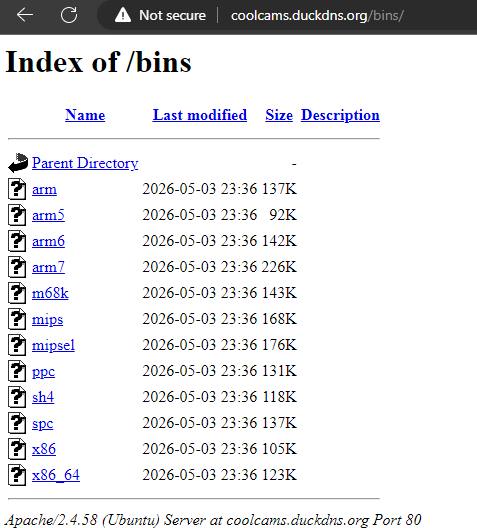 Regardless, it was a good expiriment and I’m impressed with how well the AI agent worked with the IDA aswell as the quality of the reports it generated.